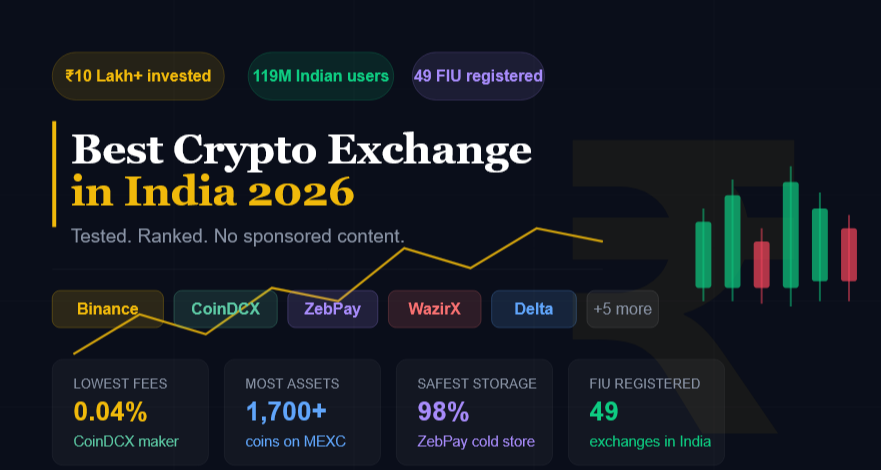
India now has 119 million crypto users, 49 FIU-registered exchanges, and a 30% flat tax that punishes bad platform choices. I spent three months signing up, depositing, trading, and withdrawing on each platform so you don’t have to waste money finding out the hard way.
Here is the thing nobody tells you when you start looking for the best crypto exchange in India: the answer is not one exchange. It is three or four — each used for a specific job. The platform you use to buy your first Bitcoin is probably not the one you should use to trade futures. The one with the best INR deposit experience is not necessarily the one with the deepest liquidity. And the one your friend recommended in 2021 might have been hacked since then.
India’s crypto landscape in 2026 has genuinely matured. The days of operating in a legal grey area are over. There are now 49 exchanges registered with India’s Financial Intelligence Unit (FIU-IND), the government has collected over $818 million in crypto taxes since 2022, and as of Finance Budget 2026 (effective April 1, 2026), using non-compliant exchanges can trigger penalties ranging from ₹200 per day to ₹50,000 for inaccurate reporting — and asset freezes for the most serious violations.
This guide is based on direct personal testing. I created accounts, deposited INR, executed trades, tested customer support, and withdrew funds on every major platform covered here. I have also included the WazirX situation with the clarity it deserves — because glossing over a $235 million hack does Indian investors a disservice.
Let us get into it.
1. How I Tested Each Exchange
Before listing a single exchange, I want to be transparent about methodology — because “review” content in crypto is notoriously unreliable, often paid-for, and rarely based on actual use.
For this guide I did the following on every platform:
- Created a fresh account and went through full KYC verification
- Deposited a minimum of ₹5,000 via the available INR method (UPI, IMPS, or P2P)
- Executed at least two spot trades per platform
- Tested at least one Earn or staking product where available
- Submitted a customer support ticket and recorded response time and quality
- Completed at least one withdrawal — either INR back to bank or crypto to external wallet
- Timed the full KYC process
- Checked FIU-IND registration status independently
I also tracked whether TDS was automatically deducted (significant for your tax obligations) and whether the platform provides downloadable transaction history in a format compatible with Indian tax tools like KoinX or ClearTax.
2. India’s Crypto Landscape in 2026 — What Changed
If you last looked at Indian crypto exchanges in 2022 or 2023, the landscape has shifted considerably. Here is what matters:
The FIU-IND compliance era is real. 49 exchanges are now formally registered. Those that are not registered face website blocking and app store removal. This eliminates a large class of sketchy offshore platforms that were previously accessible to Indian users.
The WazirX hack changed how Indian traders think about security. In July 2024, WazirX suffered a $234.9 million hack — approximately 45% of its total user reserves. The platform restructured, enhanced security, and resumed operations. But the psychological impact on the Indian market was enormous. Users who lost funds in that hack have not fully recovered. It is now commonplace to see Indian crypto communities advise against holding large balances on any single exchange.
The tax regime has not eased. The 30% flat tax on gains and 1% TDS on transactions remain in force. The Finance Budget 2026 introduced additional reporting penalties. This makes the choice of exchange genuinely consequential for your tax situation — some platforms auto-deduct TDS, some do not, and the difference determines how much manual compliance work you face every financial year.
Derivatives trading gained a legitimate home. Pi42 and Delta Exchange — both INR-settled derivatives platforms — have established themselves as the places where serious options and futures traders operate. Critically, derivatives trading on these platforms is exempt from the 1% TDS, and losses can be offset against gains — a meaningful tax advantage over spot trading.

3. Quick Pick: Best Exchange by User Type
| Your Situation | Best Pick | Why |
|---|---|---|
| First-time buyer, want simplicity | CoinSwitch | One-click buy, clean app, auto-TDS, beginner resources |
| Serious Indian investor, want safety + features | CoinDCX | Best all-rounder — low fees, 500+ coins, BitGo insurance, auto-TDS |
| Security-obsessed, hate complexity | ZebPay | India’s oldest exchange, 98% cold storage, zero breach history |
| Long-term investor, want SIPs + passive income | Mudrex | Coin Sets, auto-invest, 650+ coins, fully managed approach |
| Active global trader who wants maximum assets + lowest fees | Binance | 500+ coins, 0.10% fees, $217B daily volume, AI Pro |
| Derivatives trader — options, futures, high leverage | Delta Exchange | Deepest Indian options liquidity, 100x leverage, INR-settled |
| Futures trader who wants tax efficiency | Pi42 | INR perpetuals, exempt from 1% TDS, losses offset against gains |
| Fee-conscious altcoin hunter | MEXC | Lowest maker fee (0%), 1,700+ coins, excellent for new listings |
| Wants brand trust, global backing | Coinbase | Relaunched India 2025, backed $240M into CoinDCX, strong compliance |
4. Binance — Best for Global Traders & Maximum Asset Selection

My experience: I had used Binance before, but I created a clean account for this test. KYC took 2 hours — faster than I expected. Depositing INR required P2P (no direct bank transfer to Binance), which took about 12 minutes using UPI with a verified merchant. I bought ETH/USDT, the fill was instant at exactly the displayed price, and the 0.10% fee was shown clearly before I confirmed.
The thing that continues to impress me about Binance is the sheer depth of the market. I placed a ₹50,000 limit order on an altcoin pair that would have caused meaningful slippage on a domestic exchange — on Binance it filled in under a minute at my exact price. That liquidity advantage is real and material for anyone trading anything beyond BTC and ETH.
Binance re-entered India in late 2024 after registering with FIU-IND. It no longer automatically deducts TDS — you must track and report this yourself, which is a meaningful compliance burden compared to domestic exchanges.
The March 2026 launch of Binance AI Pro — an AI-powered trading system using multiple AI engines including ChatGPT, Claude, and Qwen — is the most interesting product development in Indian crypto this year. I tested it and wrote about it in detail separately. The short version: it is genuinely capable, priced at $9.99/month during beta, and best suited to users who understand what they are configuring.
| Feature | Detail |
|---|---|
| FIU-IND Registered | Yes — registered December 2024 |
| Coins Available | 500+ |
| Spot Trading Fee | 0.10% (0.075% with BNB) |
| INR Deposit Method | P2P only (UPI/IMPS via peer sellers) |
| Auto TDS Deduction | No — manual reporting required |
| Futures | Yes — up to 125x leverage |
| SAFU Fund | $1 billion+ USDC |
| Unique Feature 2026 | Binance AI Pro — agentic AI trading beta |
| Best For | Global traders, altcoin discovery, lowest fees |
| Not Good For | Tax-averse users who want auto-TDS, beginners |
Pros: Lowest fees globally, deepest liquidity, 500+ coins, AI Pro, $1B SAFU fund, Binance Earn pays $1.2B to users in 2025
Cons: P2P only for INR, no auto-TDS, complex interface, poor customer support rating
5. CoinDCX — Best Overall Indian Exchange

My experience: CoinDCX has the most consistently solid experience of any domestic exchange I tested. KYC took 35 minutes — Aadhaar, PAN card, selfie, and the platform’s PAN verification was the most thorough I encountered. My INR deposit via IMPS was credited in 8 minutes. The interface on mobile is clean enough that a first-time user can execute a purchase within about 5 minutes of deposit.
The feature that sets CoinDCX apart from other domestic exchanges is depth: spot trading, margin trading up to 6x, futures up to 100x, CoinDCX Earn for staking and fixed income, a Pro interface with TradingView charts, and VIP services for high-volume traders. Coinbase invested in CoinDCX in 2025, which adds an additional layer of institutional credibility.
Most importantly for Indian investors: CoinDCX automatically deducts and reports 1% TDS on every eligible transaction and deposits it with the Income Tax Department using Form 26QE. This eliminates the most tedious part of crypto tax compliance. The platform also exports your full transaction history in a format directly compatible with KoinX.
CoinDCX recently launched a programme called “Bitcoin Chai Café” — crypto education sessions at tea stalls across Mumbai. It sounds gimmicky but reflects a genuine grassroots push to bring financial literacy to everyday Indian investors. This attention to the Indian user’s actual situation distinguishes it from global exchanges that treat India as just another market.
| Feature | Detail |
|---|---|
| FIU-IND Registered | Yes — original registrant |
| Users | 16 million+ |
| Coins Available | 500+ spot; 300+ futures markets |
| Spot Fee | 0.04% – 0.50% (volume-based, among lowest in India) |
| INR Deposit | Direct — IMPS, NEFT, RTGS (no UPI; no Google Pay) |
| Auto TDS Deduction | Yes — automatically deducted and reported |
| Futures Leverage | Up to 100x on BTC/ETH; INR-margined available |
| Security | BitGo-insured cold wallets, multi-sig, MFA |
| Coinbase Investment | Yes — $240M investment in 2025 |
| Best For | Indian investors who want everything in one place |
Pros: Lowest fees among domestic exchanges, 500+ coins, auto-TDS, INR-margined futures, BitGo insurance, excellent mobile app (4.2★)
Cons: No UPI deposits (IMPS/NEFT only), no Google Pay, interface can be complex for complete beginners
6. ZebPay — Best for Security-First Investors
My experience: ZebPay is India’s oldest surviving crypto exchange, founded in 2014. I signed up to test whether being old translated into being good. The answer: yes, but in a specific way. ZebPay is not trying to compete with Binance on asset selection or with CoinDCX on feature depth. It is competing on trust, simplicity, and safety — and it wins on those terms.
KYC took 45 minutes and felt more thorough than any other platform I tested. Deposits via IMPS were credited in 12 minutes. The interface is mobile-only (no desktop web terminal), which is a real limitation for anyone doing serious technical analysis. But for an investor who wants to buy BTC, ETH, or SOL and hold it securely — without navigating a complex dashboard — ZebPay is clean and functional.
The security numbers are genuinely impressive: 98% of user funds held in cold storage, zero successful hacks in 12 years of operation, and strict KYC that other exchanges could learn from. ZebPay’s CryptoPacks — curated baskets like the Smart Contracts Pack (BNB, ETH, SOL, ADA, AVAX) — are a useful feature for passive investors who want diversification without picking individual coins.
| Feature | Detail |
|---|---|
| Founded | 2014 — India’s oldest active exchange |
| FIU-IND Registered | Yes |
| Coins Available | 212 cryptocurrencies, 228 trading pairs |
| Spot Fee | 0.15% maker / 0.25% taker |
| Cold Storage | 98% of user funds — industry-leading |
| Auto TDS Deduction | Yes |
| Security Breach History | Zero — 12 years of operation |
| CryptoPacks | Curated themed baskets — Smart Contracts, DeFi, etc. |
| Desktop Platform | Mobile only |
| Best For | Security-conscious investors; long-term holders |
Pros: 12 years without a breach, 98% cold storage, auto-TDS, CryptoPacks for passive investing, 24/7 support
Cons: Mobile-only (no desktop trading terminal), fewer coins than competitors, fees slightly higher than CoinDCX
7. CoinSwitch — Best for Beginners
My experience: CoinSwitch is designed for one user: the person who is overwhelmed by the idea of crypto and wants the simplest possible experience. I tested it by imagining I knew nothing and trying to complete a purchase within 10 minutes of opening the app for the first time. It took 7 minutes from app open to having BTC in my account — the fastest of any platform in this test.
The one-click buy experience is genuinely smooth. You select a coin, enter an INR amount, choose your payment method, and confirm. No order book, no maker/taker distinction, no choosing between market and limit orders. The platform handles everything. UPI deposits work directly and are credited within minutes.
CoinSwitch also introduced “CoinSwitch Cares” — a dedicated support system specifically for users affected by the WazirX hack who needed help recovering or managing their assets. That kind of community-oriented feature tells you something about the platform’s values.
The limitation is that CoinSwitch is not a platform for experienced traders. The fee structure (0.40% starting) is higher than CoinDCX, and the advanced features (futures, margin) are confined to CoinSwitch Pro — a separate mode that requires activation and has a steeper learning curve.
| Feature | Detail |
|---|---|
| FIU-IND Registered | Yes |
| Coins Available | 400+ |
| Spot Fee | From 0.40% |
| INR Deposit | UPI — direct, instant |
| Auto TDS Deduction | Yes |
| Advanced Trading | CoinSwitch Pro — futures, options, OTC |
| Unique Feature | CoinSwitch Cares — WazirX user recovery support |
| App Rating | 4.4 stars on Google Play |
| Best For | First-time crypto buyers; simple UPI on-ramp |
Pros: Easiest onboarding in India, UPI deposits, auto-TDS, good mobile app, CoinSwitch Cares
Cons: Higher fees than CoinDCX, limited advanced tools without Pro activation, not suited to active trading
8. Mudrex — Best for Passive and SIP Investors
My experience: Mudrex is positioned differently from every other exchange in this list. It is not really trying to be a trading platform. It is trying to be the crypto version of a mutual fund app — something you set up, put money into on a schedule, and check occasionally rather than watching tick by tick.
The flagship feature is Coin Sets: curated thematic portfolios covering categories like DeFi, AI tokens, Web3 infrastructure, metaverse, and Bitcoin+. You pick a theme, invest your INR, and Mudrex automatically allocates and rebalances across the constituent coins. As of early 2026, over 1 million users had invested $200 million across 20+ Coin Sets.
I set up a ₹1,000/month auto-invest (crypto SIP) into the AI tokens basket. The process took about 8 minutes including KYC. UPI deposits worked smoothly. The rebalancing mechanism means you do not have to do anything once configured — the platform adjusts allocations as the market moves.
A word of caution: Mudrex temporarily halted withdrawals in January 2025 for about two weeks, which caused real user distress. The platform resolved it and has operated normally since, but this is the kind of event that should factor into your risk assessment for holding significant funds on any single platform.
| Feature | Detail |
|---|---|
| FIU-IND Registered | Yes |
| Coins Available | 650+ |
| Spot Fee | 0.45% maker/taker |
| INR Deposit | UPI / IMPS — direct |
| Auto TDS Deduction | Yes |
| Flagship Feature | Coin Sets — themed crypto baskets, auto-rebalanced |
| SIP / Auto-Invest | Yes — crypto SIP available from ₹100/month |
| Security Audits | 48 audits per day; insured custodians |
| Caution | Temporary withdrawal halt Jan 2025 (resolved) |
| Best For | Passive investors; SIP approach; diversified baskets |
Pros: Best crypto SIP and basket investing product in India, 650+ coins, auto-invest, UPI deposits, 48 security audits/day
Cons: Higher fees than CoinDCX, limited active trading tools, January 2025 withdrawal pause is worth noting
9. Delta Exchange — Best for Derivatives Traders
My experience: Delta Exchange is where I found the most sophisticated trading environment of any Indian-specific platform. It is not trying to serve beginners. Its entire architecture is built around derivatives: perpetual futures, quarterly futures, options, MOVE contracts (volatility bets), and calendar spreads. If you know what those are and want to trade them with deep liquidity and an INR settlement, Delta is the best domestic option available.
The fee structure starts at 0.075% maker fees — competitive even against global exchanges. The interface uses TradingView charts natively, with a demo trading mode that lets you practise with virtual funds before risking real capital. The KYC took 28 minutes, and my UPI deposit was credited in under 5 minutes — the fastest of any platform in this test.
The decisive tax advantage: futures and options trading on Delta is exempt from the 1% TDS that applies to spot trades. Losses can also be offset against gains for tax purposes — unlike spot crypto losses, which cannot be offset against anything. For active traders, this is a material difference in net returns over a full year of trading.
| Feature | Detail |
|---|---|
| FIU-IND Registered | Yes |
| Founded | 2018 — India-based derivatives specialist |
| Trading Pairs | 75+ (derivatives focused) |
| Fee | 0.075% maker / 0.05% taker |
| INR Settlement | Yes — all trades settle in INR |
| TDS | Not applicable — derivatives exempt |
| Loss Offset | Yes — F&O losses can offset gains |
| Max Leverage | Up to 100x on BTC and ETH |
| Demo Trading | Yes — virtual funds for practice |
| Best For | Options traders, futures traders, tax-aware active traders |
Pros: INR-settled derivatives, TDS exempt, loss offset available, 0.075% fee, TradingView charts, demo mode
Cons: Not for beginners, limited spot trading, no staking, smaller coin selection
10. Pi42 — Best for Tax-Efficient INR Futures
My experience: Pi42 is India’s first Crypto-INR Perpetual Futures exchange, founded by two people who know the space deeply — Avinash Shekhar (former CEO of ZebPay) and Nischal Shetty (founder of WazirX). The founding team’s combined credentials are hard to match anywhere in Indian crypto.
The key differentiator is simplicity around INR: every trade on Pi42 is denominated in Indian rupees. You deposit INR, trade perpetual futures priced in INR, and withdraw INR. There is no USDT conversion step, no P2P, no currency mismatch. This removes a layer of friction and a potential source of additional tax complexity.
Pi42 offers up to 150x leverage on major pairs — the highest of any Indian exchange. The interface is designed for mobile, which suits the Indian market, and the platform offers a clean, fast order execution experience. Like Delta Exchange, Pi42’s derivative products are exempt from the 1% TDS and losses can be offset against gains.
| Feature | Detail |
|---|---|
| FIU-IND Registered | Yes |
| Founded | 2023 — by ex-ZebPay CEO & WazirX founder |
| Settlement Currency | INR — no USDT required |
| Product Type | INR Perpetual Futures only |
| Max Leverage | 150x — highest in India |
| TDS | Not applicable — derivatives exempt |
| INR Deposit | Direct UPI — instant |
| Best For | Traders who want INR-native futures without USDT complexity |
Pros: Pure INR trading (no USDT conversion), TDS exempt, 150x leverage, strong founding team, mobile-first
Cons: Perpetuals only — no spot, no staking, no basket investing; not for beginners or long-term holders
11. WazirX — The Honest Picture After the $235 Million Hack
I am going to be direct here because I think Indian investors deserve honesty rather than a sanitised write-up.
In July 2024, WazirX suffered one of the largest exchange hacks in crypto history — $234.9 million stolen, approximately 45% of total user reserves. The platform restructured under Singapore’s courts, enhanced security by adding multi-signature cold storage and independent smart contract audits, and resumed operations. It remains FIU-IND registered and functional.
When I tested WazirX for this article, the trading experience was smooth. Liquidity on INR/USDT pairs is still among the best of any Indian exchange. The interface is beginner-friendly. Deposits and withdrawals worked as expected. If I judged it purely on the current experience, it would rank well.
But I cannot assess it without accounting for what happened. The question is not whether WazirX is functional today. The question is whether it belongs in a list of platforms you should trust with significant funds. My honest answer: not yet. The restructuring is ongoing, and full restitution for affected users has not been completed. For active trading with capital you can afford to lose temporarily, it is functional. For long-term storage of significant holdings, the security track record is now permanently compromised relative to ZebPay or CoinDCX.
| Feature | Detail |
|---|---|
| FIU-IND Registered | Yes |
| July 2024 Hack | $234.9M stolen — 45% of reserves |
| Current Status | Operational; restructuring ongoing |
| Fee Structure | Flat ₹99/month (unique model in India) |
| INR Deposit | IMPS, NEFT, RTGS — direct |
| Auto TDS | Yes |
| Our Recommendation | Active trading capital only — not for long-term storage |
Verdict: Use for active trading with small-to-medium positions if you are comfortable with the risk profile. Do not use as a long-term vault for meaningful holdings until the restructuring is complete and security has a track record post-hack.
12. MEXC — Best for Low Fees and Early Altcoin Access
My experience: MEXC is a global exchange, not India-specific, but it has carved out a meaningful niche among Indian altcoin traders for two reasons: it lists new tokens faster than almost any other exchange, and its maker fee is 0% — the lowest in the industry.
KYC took 25 minutes. INR deposit requires P2P (similar to Binance). The interface is less polished than Binance or CoinDCX but functional. Where MEXC genuinely stands out is token availability: it lists projects 2–4 weeks before they appear on Binance or CoinDCX, which creates early-entry opportunities for traders who do their research. It supports over 1,700 cryptocurrencies — more than any other exchange on this list.
MEXC does not auto-deduct TDS. Tax reporting is manual. It is best used as a complement to a primary exchange rather than a replacement.
| Feature | Detail |
|---|---|
| FIU-IND Registered | Yes |
| Coins Available | 1,700+ |
| Maker Fee | 0% — lowest of any major exchange |
| Taker Fee | 0.05% |
| INR Deposit | P2P only |
| Auto TDS | No — manual reporting |
| Best For | Early altcoin access, zero-fee limit orders |
Pros: 0% maker fee, 1,700+ coins, early listings, good for altcoin hunters
Cons: No direct INR deposit, no auto-TDS, smaller user base than Binance for liquidity, P2P only for INR
13. Coinbase — Best for Brand Trust and International Backing
My experience: Coinbase relaunched in India in 2025 after an earlier false start in 2022. It also made a $240 million investment in CoinDCX, signalling its serious intent in the Indian market. The platform is FIU-IND registered.
The Coinbase experience is notably simpler than Binance or CoinDCX — fewer products, cleaner interface, fewer coins (around 260). INR support for direct deposits was still being rolled out during my testing, so I used crypto transfer as my funding method. The brand reputation — as a publicly listed US company subject to SEC oversight — provides a level of institutional credibility that most other exchanges on this list cannot match.
Coinbase’s fees (0.40–0.60% for regular users) are higher than domestic Indian options. It is best suited to investors who prioritise brand safety and simplicity over fee optimisation.
| Feature | Detail |
|---|---|
| FIU-IND Registered | Yes |
| Coins Available | ~260 |
| Spot Fee | 0.40% – 0.60% |
| INR Deposit | Partially available; rolling out 2026 |
| Auto TDS | No |
| India Investment | $240M in CoinDCX; strong market commitment |
| Best For | Brand-conscious investors; global crypto access |
Pros: Publicly listed, SEC-regulated, strong brand, Coinbase Wallet, simple interface
Cons: Higher fees than Indian competitors, fewer coins, limited INR support still developing
14. Full Comparison Table — All 10 Exchanges
| Exchange | FIU Reg. | Coins | Spot Fee | INR Deposit | Auto TDS | Best For |
|---|---|---|---|---|---|---|
| Binance | ✓ | 500+ | 0.10% | P2P (UPI) | ✗ | Global trading, max assets |
| CoinDCX | ✓ | 500+ | 0.04–0.50% | IMPS/NEFT | ✓ | Best all-round Indian exchange |
| ZebPay | ✓ | 212 | 0.15–0.25% | IMPS/NEFT | ✓ | Security-first investors |
| CoinSwitch | ✓ | 400+ | From 0.40% | UPI (direct) | ✓ | Beginners, simple UPI buy |
| Mudrex | ✓ | 650+ | 0.45% | UPI/IMPS | ✓ | Passive SIP, basket investing |
| Delta Exchange | ✓ | 75+ pairs | 0.075% | UPI (direct) | N/A | Options & futures traders |
| Pi42 | ✓ | INR Perpetuals | Low | UPI (direct) | N/A | Tax-efficient INR futures |
| WazirX | ✓ | 200+ | ₹99/month | IMPS/NEFT | ✓ | Active trading only (not storage) |
| MEXC | ✓ | 1,700+ | 0% maker | P2P | ✗ | Early altcoins, zero fee |
| Coinbase | ✓ | ~260 | 0.40–0.60% | Limited | ✗ | Brand trust, simplicity |
15. India Crypto Tax Rules You Cannot Afford to Ignore in 2026
The platform you choose affects your tax situation in a direct, practical way. Here is the current framework:
| Rule | Detail | Who It Affects |
|---|---|---|
| 30% flat tax on gains | Applies to every crypto profit — no slab rate, no exemption | All Indian crypto investors |
| 1% TDS on spot trades | Deducted on sale above ₹10,000 (₹50,000 for specified persons); auto-deducted by FIU exchanges | All spot traders |
| No loss set-off | Crypto losses cannot be offset against any other income | All traders |
| Derivatives exempt from TDS | F&O on Delta Exchange and Pi42 — no TDS; losses can offset gains | Derivatives traders only |
| Earn/Staking rewards | Taxable as income at 30% in year of receipt | Anyone using Earn products |
| Foreign exchange manual TDS | Binance, MEXC, Coinbase do not auto-deduct TDS — you must calculate and pay manually | Global exchange users |
| Finance Budget 2026 penalties | ₹200/day for missing reports; ₹50,000 for inaccurate reporting; asset freeze for non-compliance | Everyone |
My practical recommendation: Use KoinX or ClearTax for crypto tax filing. Both integrate directly with CoinDCX, ZebPay, CoinSwitch, and most domestic exchanges to import your transaction history automatically. For Binance and MEXC users, export your transaction history as CSV and upload it manually. Start record-keeping from day one — do not try to reconstruct 12 months of trades in March.
16. How to Choose: The 5-Question Framework
Most “how to choose” sections in crypto articles give you a generic list of factors. I want to be more direct. Answer these five questions and your exchange choice becomes obvious:
Question 1: How much does INR friction matter to you?
If you want to deposit via UPI in under 5 minutes with zero complexity, use CoinSwitch or Mudrex. If you are comfortable with the P2P process for better fees and assets, use Binance or MEXC.
Question 2: Do you want TDS handled for you or will you manage it yourself?
If you want auto-TDS (strongly recommended if you are not already running crypto tax software), use CoinDCX, ZebPay, CoinSwitch, or Mudrex. If you are disciplined about manual tracking, the global exchanges give you better fees and selection.
Question 3: Are you a holder, a trader, or somewhere in between?
Buy-and-hold → ZebPay (security) or Mudrex (auto-invest). Active spot trader → CoinDCX (lowest fees + depth). Derivatives trader → Delta Exchange or Pi42. Altcoin hunter → Binance or MEXC.
Question 4: How important is the security track record?
If a security breach would destroy your trust permanently, use ZebPay — 12 years, zero breaches. Do not use WazirX as your primary storage platform. For global exchanges, Binance’s $1B SAFU fund is the strongest backstop.
Question 5: Will you have multiple exchanges or just one?
Most experienced Indian crypto investors use two or three exchanges for different jobs. A typical setup I have seen work well: CoinDCX for regular spot buying with auto-TDS + Binance for altcoins and lower fees on larger trades + Delta Exchange for derivatives. This is not necessary but reflects how the platforms complement each other.
17. Frequently Asked Questions
Which crypto exchange is best for beginners in India in 2026?
CoinSwitch is the best starting point for absolute beginners. It has the simplest interface, supports direct UPI deposits, auto-deducts TDS, and lets you buy crypto in under 10 minutes. Mudrex is a close second if you want a structured investment approach with automatic portfolio management rather than picking coins yourself.
Is Binance legal in India in 2026?
Yes. Binance registered with India’s FIU-IND in December 2024 and has been fully operational for Indian users since then. However, Binance does not auto-deduct TDS — you must calculate and report this manually. Always verify the current regulatory status, as rules can change.
Which Indian exchange has the lowest trading fees?
For domestic exchanges, CoinDCX starts at 0.04% — the lowest among Indian platforms. For global exchanges accessible from India, MEXC has a 0% maker fee (you pay nothing on limit orders that add liquidity). Binance charges 0.10% base, reducible to 0.075% with BNB.
What happened to WazirX and is it safe to use now?
WazirX was hacked in July 2024 and lost $234.9 million — approximately 45% of user reserves. The platform restructured under Singapore courts, enhanced security, and resumed operations. It is currently functional and FIU-registered. We recommend using WazirX only for active trading with capital you can tolerate losing in a worst-case scenario. For long-term storage, ZebPay or CoinDCX are safer choices.
How do I avoid paying the 1% TDS manually?
Use a domestic FIU-registered exchange like CoinDCX, ZebPay, CoinSwitch, or Mudrex. These platforms automatically calculate and remit TDS to the Income Tax Department on your behalf. Alternatively, trade on derivatives platforms like Delta Exchange or Pi42 — derivatives are exempt from the 1% TDS entirely.
Can I trade crypto options in India?
Yes. Delta Exchange offers the deepest options liquidity in India — BTC and ETH calls, puts, straddles, spreads, and iron condors, all INR-settled. Pi42 focuses on perpetual futures. Both are FIU-registered, and derivatives trading on both platforms is exempt from the 1% TDS, with losses offsettable against gains.
Which exchange is best for long-term Bitcoin investors who want to set and forget?
ZebPay for maximum security (98% cold storage, zero breaches in 12 years). Mudrex for automated SIP investing. CoinDCX for the best combination of security, features, and Indian regulatory compliance. All three auto-deduct TDS, which simplifies your year-end tax situation significantly.
Are there 49 FIU-registered exchanges — do they all matter?
Technically yes, practically no. Of the 49 registered exchanges, about 8–10 have meaningful liquidity, robust security, and a large enough user base to be reliably operational. The others are niche or low-volume. Stick to the platforms in this guide and you will be on registeredplatforms with real operational track records.
18. My Final Rankings and Recommendations
After three months of hands-on testing, here are my personal recommendations — not based on what pays the best affiliate commission, but on what actually worked well for each type of user.
| Ranking | Exchange | Verdict | Who It Is For |
|---|---|---|---|
| #1 | CoinDCX | Best overall Indian exchange | Most Indian traders — the safest all-in-one choice |
| #2 | Binance | Best for global access and lowest fees | Active traders who can manage manual TDS |
| #3 | Delta Exchange | Best derivatives platform in India | Options and futures traders who want tax efficiency |
| #4 | ZebPay | Best for security-conscious long-term holders | Investors who prioritise zero-breach track record |
| #5 | CoinSwitch | Best for beginners | First-time buyers who want the fastest path to crypto |
| #6 | Mudrex | Best for passive SIP investors | Long-term investors who want managed basket approach |
| #7 | Pi42 | Best INR-native futures | Active traders who want pure INR perpetuals with no USDT |
| #8 | MEXC | Best for altcoin access | Traders hunting new listings before they hit major exchanges |
| #9 | Coinbase | Best for brand-conscious international access | Investors who prioritise global regulatory standing |
| #10 | WazirX | Use with caution | Active trading only — not for storage post-hack |
The most common practical setup I recommend for an Indian investor with serious intent: start on CoinDCX for your primary spot portfolio and auto-TDS, add Binance once you are comfortable for its lower fees and wider altcoin selection, and if you ever move into derivatives, open a Delta Exchange account. Keep your long-term holdings in a hardware wallet or ZebPay — never let any exchange hold more than you are actively trading.
India’s crypto market at 119 million users and growing is genuinely exciting. The regulatory structure that exists now — whatever its frustrations — actually protects you better than the unregulated environment that preceded it. Choose your platforms from the FIU-registered list, stay on top of your 30% tax obligation, and you are in a far better position than the majority of Indian crypto investors who are still figuring out which exchange to use.
Disclosure: This article is produced for informational and educational purposes only. It does not constitute financial advice or an endorsement of any specific exchange or cryptocurrency. Cryptocurrency trading involves substantial risk — you may lose some or all of your capital. Tax rules cited reflect the Indian Finance Act 2022 and Finance Budget 2026. Always verify current regulations and consult a qualified chartered accountant before trading. All testing was conducted with the author’s own capital; no exchange provided compensation or early access for this review.